|
|
|
|
Monsieur Gurdjieff,
the Psychology of Common Sense
and Neurosciences
Part One
|
Albert Einstein used the term “Psychology of Common Sense” (PCS) to define the entire group of notions, schemes and convictions about oneself, others and the world around us that are instilled in us in our first eighteen years of life. It is precisely this bundle of notions, schemes and convictions that G.I.Gurdjieff tells us we must absolutely abandon in order to free the ‘butterfly’ within us from the chrysalis where it is imprisoned, and which is an obstacle to the ‘alchemical transformation’ of the ‘base metal’ of our interior fragmentation into the Gold of a ‘permanent me’.
But let's take things one step at a time.
* * *
Each one of us is born within a certain culture, a group of people who share a certain system of values and that are bound together by a fundamental consensus about how things are and how they should be. The primary aim of educating the child lies in moulding and shaping the youngster’s ‘psychological clay’ to make it as similar as possible to the behavioural models that society has established and defined as ‘normal‘.
|
|
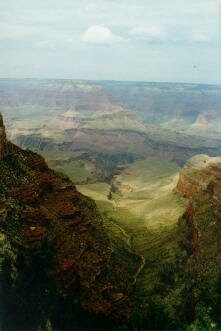
We can imagine that at birth our mind is like a vast plain, without valleys or hills, where the flow of perceptions begins to run freely, like a river carving its own course. In reality we need to imagine not one but tens, hundreds, thousands of rivers starting to cut deep channels in that plain, transforming it slowly and inexorably into a completely different landscape, made of valleys and hills, gullies and insurmountable cliffs, and especially a certain number of ‘psychological basins’ of different dimensions where the waters run together. Within this landscape the new flows of perception can no longer run freely, but have to follow the channels already cut, contributing in turn to deepen them, and, consequentially, to increase their capacity to draw in other psychic flows (for this reason we will call them ‘basins of psychic attraction’, in tune with
|
|
|
the modern language of Complex System Physics).
Culture and education readily interfere with this natural process, starting to build dams, barriers, locks and canals in order to control the turbulence of those currents, to direct them along preferred courses and above all to limit each individual’s ‘psychic attraction basins’ (PAB) to specific areas of his or her mental territory. And it is these artificial boundaries imposed upon the mental landscape that define the limits of ‘Common Sense’ (we will call it the ‘CS Region’) for any given culture: anyone who oversteps these limits will no longer be able to relate effectively with their own social group, leading to ‘deviant’, ‘abnormal’ behaviour, they will immediately be catalogued, at best, as maladjusted, eccentric or transgressive, at worst as mad or criminal. They will be expelled, imprisoned, fought against or reduced to silence. In extreme cases they may even be tortured or burnt at the stake (once it was physically, nowadays only psychologically, but the effects are similar).
Thus we are only apparently free to think, wish and imagine what we want. In reality our entire mental life is strictly confined within our CS region, defined by our culture: and this is a psychological prison far more powerful than any prison made of bricks and metal bars, for the simple reason that we are not even aware of it. As a fish is not aware of the water it swims in, we do not even see this prison, and even less do we feel the need to escape from it. Indeed, our conditioning is such that, if we occasionally happen to put our nose outside it, we immediately feel unpleasantly dizzy, guilty or ashamed for reasons that we cannot explain, but which we classify as negative sensations, and try to suppress. Without realising that with them we also suppress the fundamental urge to explore new mental territories that has always been the basis for the human creative drive, for that change in interior perspective that is the real motor for evolution and progress.
|
continued.....
|
|
|
|
| Conferences |
|
Conferences about the
|
 |
|
 Fourth Way teaching Fourth Way teaching
|
| Write to us |
|
Write to our
|
|
|
Editorial staff
|
| The mail |
|
Our editorial
|
|
|
Staff answers
|
| Tales |
|
The traditional
|
|
|
initiation tales
|
|
|